Châteaux in Dordogne for your wedding
Dordogne has more than 1,000 châteaux, making it one of the French départements with the greatest concentration of castles. For a wedding, that dizzying figure boils down to one question: how do you choose? Here is my shortlist, with what makes each place special for photography. As a wedding photographer in Dordogne, I travel all over the département, from the Périgord Vert in the north to the Périgord Pourpre around Bergerac.
Château de Fayolle
The Château de Fayolle, in Tocane-Saint-Apre, is one of my favourites in the Périgord Vert. It is an 18th-century listed historic monument, with two buildings dating from 1766 and 1893, an Italian-style theatre and a consecrated chapel, all set in 55 hectares (about 135 acres) of parkland.
The theatre and the chapel make rare backdrops for couple portraits, very different from the usual large reception rooms. Outside, the tree-lined paths and the peace and quiet lend themselves especially well to photos at the end of the day.
Fayolle is one of my favourite châteaux in Dordogne: its Italian-style theatre is a setting I have not seen anywhere else in the area.
Château de la Côte
The Château de la Côte, in Biras, not far from Brantôme, is a château hotel whose origins go back to the 15th century. It sits in eight hectares (about 20 acres) of grounds planted with centuries-old trees, with box-lined paths and an open view over the Périgord Vert countryside.
It is a place that offers a lot of flexibility for photos: the wooded grounds allow for varied walks throughout the day, and having a hotel on site makes things simpler for couples and guests who are staying there.
Château de Jumilhac
Jumilhac-le-Grand is the most unusual château on my list. Its towers topped with pepper-pot roofs make it look almost like a fairy-tale set. Located in the Périgord Vert, in the north of the département, it is surrounded by the river Isle and deep forests. This is a château for couples who want something unique and out of the ordinary, far from the beaten track.
Château de Bourdeilles
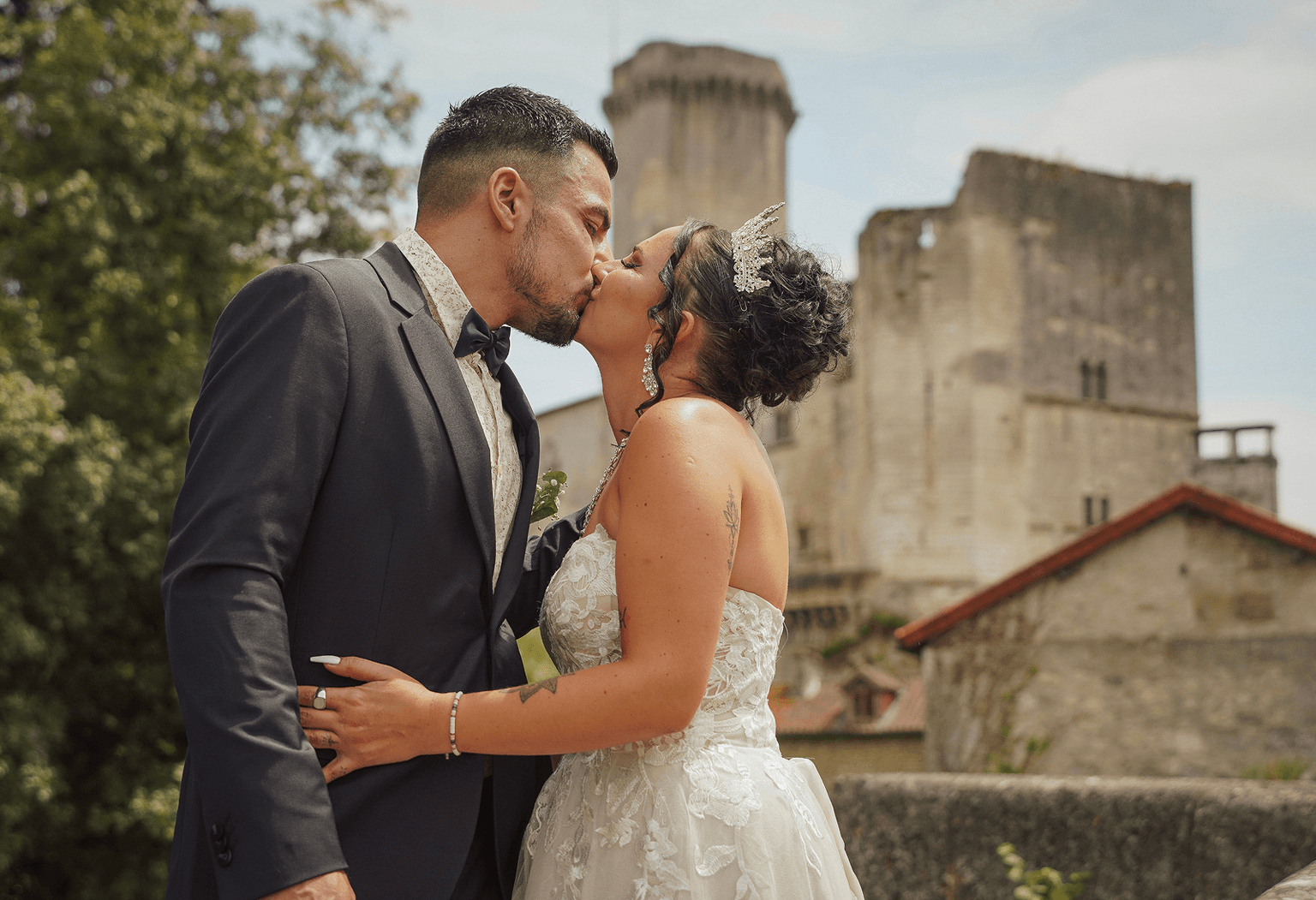
Bourdeilles is one of the châteaux tourists know least, and one of my favourites for intimate weddings. It is actually made up of two buildings side by side: a 13th-century medieval keep and a 16th-century Renaissance wing. That contrast gives very varied spaces for photos. I have already photographed several weddings there, and it is a place I know well.
The château stands on the banks of the Dronne, on a very photogenic bend in the river. The reflections on the water in the evening are extraordinary. For your couple portraits, I recommend setting aside time by the river and on the medieval bridge nearby.
Château de Hautefort
Hautefort was built as a stately residence rather than a fortress. With its blue slate roofs, formal French gardens and open terraces, it looks more like a Loire Valley château than the medieval strongholds of the Périgord Noir. That is what makes it different, and it is its great strength.
Hautefort is especially well suited to elegant, romantic weddings. The gardens are lovely for daytime photos, the terraces look out over the Périgord hills, and the interior, when it is open, offers richly decorated rooms for indoor portraits. A "classic" venue in the best sense of the word.
Château de Château-l'Évêque
A few minutes from Périgueux, the Château de Château-l'Évêque was for centuries the residence of the bishops of Périgord. Built in the 14th century and reworked during the Renaissance, it is now surrounded by 17 hectares (about 42 acres) of parkland crossed by a river and a pond.
The 14th-century Salle des Gardes, with 270 m² (around 2,900 sq ft) over two levels and a large terrace, makes a setting that is both intimate and spectacular for a reception. The grounds, with their riverbanks and historic rose garden, are ideal for photo walks throughout the day, as a couple or with your guests.
What to plan for a château wedding
A few practical points if you are considering a château wedding in Dordogne. First, book early: the most sought-after châteaux are often fully booked two to three years ahead for spring and summer weekends. Second, visit the venue with your photographer before the big day: together, we can find the best spots and work out where the sun will be at the time of your ceremony. If you live abroad and cannot make the trip, we can go over the venue together by email; my destination wedding page explains how we prepare from a distance.
Third, have a plan B for the weather: the outdoor spaces are what make these places so beautiful, but the weather in Dordogne can be changeable. When I work at a château, I always look for sheltered spots or indoor rooms where we can still take good photos if the weather does not play along.
My advice: don't choose a château only for its prestige or the photos you have seen online. Visit it at the time of your planned ceremony, see how the light falls, get a feel for the atmosphere. The place that moves you most will always be the best one for your photos.